Read the utility name on each meter's bill first
Pull the latest bill for every meter you want solar to cover and write down the utility on it, before anyone draws a layout. In Ripon, that name sets the size limit, whether one array can serve more than one meter, and how exports are paid.
Ripon is one of the "Four Cities Area" cities, with Escalon, Riverbank and Oakdale, where Public Utilities Code §9610 put the area inside both PG&E's and Modesto Irrigation District's (MID) service territory. The statute's original period ran through December 31, 2025. In July 2026 the two utilities filed a joint application with the CPUC to extend the arrangement for 25 years; a decision was still pending when we checked in November 2026. The City's undated resource directory calls PG&E "the primary supplier" and says MID "currently provides power to some local industries" and is "working toward supplying power to the residents."
The City's own wording points to PG&E on most household bills and MID on some. We can't say which streets are which, and nobody quoting you should guess. Check the bill.
Two kinds of Ripon property feel this differently:
- A city-limits house on a subdivision lot. Usually one meter. Its utility sets the size cap and export credit, and the array usually goes on the roof.
- An orchard or rural parcel with a Ripon address. Often a house meter plus a separate meter for a well pump, shop or barn. Two meters can mean two utilities, two size caps and two applications.
A Ripon mailing address also doesn't prove the parcel is inside city limits. That changes the permit desk and, on PG&E wires, whether Ava Community Energy supplies the power.
Irrigation districts sit outside the state's Solar Billing Plan. EcoGen's California solar incentives guide says so for Modesto: the district sets its own rules, so ask for the current export price in writing. If any meter is on MID, settle that before anything else.
How MID, PG&E and PG&E with Ava size and credit a system
| Rule | MID | PG&E (bundled supply) | PG&E wires + Ava supply |
|---|---|---|---|
| Solar program | NEM 2.0, MID's own net metering schedule | Net Billing Tariff (Solar Billing Plan) on the E-ELEC rate | Same PG&E tariff; Ava pays the export credits |
| Size cap | 115% of that meter's last 12 months of use; planned load not counted | Up to 12-month use, or up to 150% with a signed oversizing attestation | Same as PG&E |
| Several meters | One solar system per meter, on the same premises | One array can serve several meters through load aggregation | PG&E rule applies; ask whether Ava supports aggregation |
| Export credit | Flat $0.0760 per exported kWh, not banked | Hourly values, "usually lower than import rates", plus a small bonus | Hourly credits, plus $0.025/kWh for 3–8 p.m. exports (non-CARE/FERA) |
| Application | Paper package, by mail or in person; $900 below 100 kW AC | PG&E interconnection request | PG&E interconnection request |
Four terms the table leans on:
- Meter vs account. The meter measures one service; the account is how it is billed. Ask whether your well-pump meter is billed as its own account.
- Demonstrated load. MID's phrase for what a meter actually used in the past 12 months. A heat pump you plan to buy doesn't count.
- Export credit vs retail. Retail is what you pay per kilowatt-hour (kWh) from the grid; the export credit is what a kWh your panels send out earns.
- E-ELEC. The PG&E time-of-use rate Solar Billing Plan customers must take, with a 4–9 p.m. peak.
MID is the strict one on size. On its solar program page and in its May 2026 handbook, MID says oversized applications "will NOT be approved and will be mailed back." MID offers no solar rebates.
PG&E is looser on size but charges to share. Its Schedule NBT, effective August 28, 2026, charges $25 per account to set up load aggregation and $5 per account per month. Under the current tariff, aggregated customers do qualify for net surplus compensation, the yearly payment for leftover credits, whatever older fact sheets say. PG&E's export bonus is about 0.9¢ per kWh in 2026 and about 0.4¢ in 2027. Sources disagree on whether the application date or the permission-to-operate date sets it, so ask which year the quote assumes.
Where Ava fits
Ava Community Energy lists Ripon among cities that "have not voted to join Ava." Unincorporated San Joaquin County joined, with service starting in 2026, and irrigation-district customers are not eligible.
So a PG&E meter inside Ripon city limits stays on PG&E bundled supply. A PG&E meter on unincorporated land with a Ripon address moves to Ava unless you opt out. Ava enrolls county solar customers by PG&E true-up month from June 2026 through April 2027, and opt-outs open 60 days before your month. An MID meter is outside Ava entirely.
Worked example: one orchard property, two meters, two utilities' answers
Run one Ripon-area property through the table and the design changes with the name on the bills.
Illustrative example. A Ripon-area property has two meters. The house uses 12,000 kWh a year; a separate well-pump and shop meter uses 8,000 kWh a year (both illustrative; use your real totals). The owner wants one ground array in an open strip beside the orchard.
Yield assumption (Modeled estimate): 1,653 kWh per kW of panels per year for a south-facing ground mount tilted 30°, from an NREL PVWatts run for a Stockton point about 17 miles away, with 14% losses and no shade. MID sizes with its own calculator, so its number will differ.
If MID runs both meters:
- House meter cap: 115% × 12,000 kWh = 13,800 kWh a year, or 13,800 ÷ 1,653 ≈ 8.3 kW (Illustrative calculation).
- Well/shop meter cap: 115% × 8,000 kWh = 9,200 kWh, about 5.6 kW (Illustrative calculation), and only as its own system on that meter.
- Result: two systems, two $900 interconnection fees and two MID generation meters.
- One combined 12 kW array on the house meter would make about 19,840 kWh a year (Illustrative calculation), far over the 13,800 kWh cap. MID would mail it back as oversized.
- Exports earn $0.0760 per kWh. A kWh used on the spot avoids MID's Schedule D energy charge of $0.15279 to $0.21349 per kWh (MID's posted 2025 schedule, before adjustment charges), so self-use is worth about two to almost three times an export (Illustrative calculation).
If PG&E runs both meters (bundled in city limits, or Ava supply on unincorporated land):
- One 12 kW ground array makes about 19,840 kWh, about 99% of the combined 20,000 kWh (Illustrative calculation), within PG&E's limit without an attestation.
- The house meter is the generating account; the well/shop meter joins through load aggregation if the parcels are the same or contiguous and solely owned, leased or rented by you. On Ava supply, confirm that Ava supports the arrangement before paying for the design.
- Aggregation fees: $25 × 2 accounts = $50 setup, plus $5 × 2 accounts × 12 months = $120 a year (Illustrative calculation).
- Exports are valued hourly, usually below import prices, plus the small bonus. With Ava, 3–8 p.m. exports earn $0.025 per kWh extra (non-CARE/FERA).
On MID, the array follows the meters: two smaller systems, each sized to its own history, worth most when the power is used where it is made. On PG&E, the array can follow the land: one array in the best spot, shared for a small monthly fee.
If one bill says MID and the other PG&E, PG&E's aggregation gathers only the PG&E accounts; the MID meter needs its own system under MID's cap. Have each utility confirm before you pay for a design.
Before the visit: pull 12 months of kWh per meter
The example only works with real numbers per meter. Collect these yourself so every installer prices the same facts:
- The utility on each bill. House, well pump, shop, barn.
- Twelve months of kWh per meter. Totals meter by meter, not one number for the property.
- MID's Release of Information form, if a meter is on MID. MID uses it to release the meter's demonstrated load to your installer. Sign it before the design; a design built on a guess can come back as oversized.
- Which meters solar should cover. House only, or house plus well? On MID, that answer changes the whole plan.
- Parcel ownership. PG&E aggregation needs the meters on the same parcel or on contiguous parcels you solely own, lease or rent. Bring the parcel numbers.
- What is underground. Well head and pump line, septic tank and leach field, irrigation mains, ditches, old trenches.
- City or county. If unsure, ask the City's Building Department.
On an orchard parcel this list is the slow part. It is also what keeps two installers from quoting two different properties.
Which desk files your permit: City of Ripon or the County
Parcel location decides the building desk; the utility decides the interconnection desk.
| Desk | Applies to | How it works | Ask |
|---|---|---|---|
| City of Ripon Building Department, 259 N Wilma Ave | Parcels inside city limits | Online permits through the City's OpenGov portal; residential plans checked in-house | Automated solar permit or plan review for my system? |
| San Joaquin County solar permits | Unincorporated parcels, including acreage with a Ripon address | Building permit for roof and ground arrays; SolarAPP+ for eligible rooftop systems | Does a ground mount need Planning sign-off first? |
| MID interconnection | MID meters | Paper application; paperwork review 1–3 weeks, engineering review 1–3 weeks; install only after engineering approval | Will the City or County final be under six months old when MID inspects? |
| PG&E interconnection | PG&E meters | Installer files PG&E's interconnection request | Which bonus year and rate does the quote assume? |
The automated permit question
California's SB 379 requires cities with 5,000 to 50,000 residents in counties above 150,000, which takes in Ripon (about 16,000 people), to offer an online, automated permit for qualifying residential solar. The Ripon City Council approved an automated permitting platform from Symbium in August 2025, the Manteca Bulletin reported. Whether it is live for your system is something to ask the Building Department. Automated permits are built for qualifying rooftop systems, so expect a ground mount with a trench to go through regular plan review.
MID's six-month window
MID inspects only after the City or County final, and that final must be under six months old when you request MID's inspection. MID normally inspects within 12 working days and emails a permission-to-operate (PTO) letter, the go-ahead to switch on, within 10 working days of a pass. A reinspection costs $250. Applications not interconnected within a year are cancelled, with one six-month extension. The quote should name who books each step, because a stalled inspection can push the City or County final past six months.
Check the Ripon business license before you sign
The City of Ripon says all contractors working in Ripon must hold a license registered with the City, and "an out-of-town license is not sufficient." That covers work inside city limits.
The City's business license page lists the 2026 fee for contractors and subcontractors at $172.25. Licenses expire December 31, and applications received after November 30 are processed for the next year.
Signing in late 2026 for city-limits work? Ask for the contractor's current Ripon license and whether it covers the month the crew is on site; a January start needs a renewed one.
Then check the state license. Residential solar needs a C-46 (Solar) or C-10 (Electrical) license. Look up the number on the CSLB license check, confirm it is active, and compare the name with the contract.
Plan the ground array around Ripon's open questions
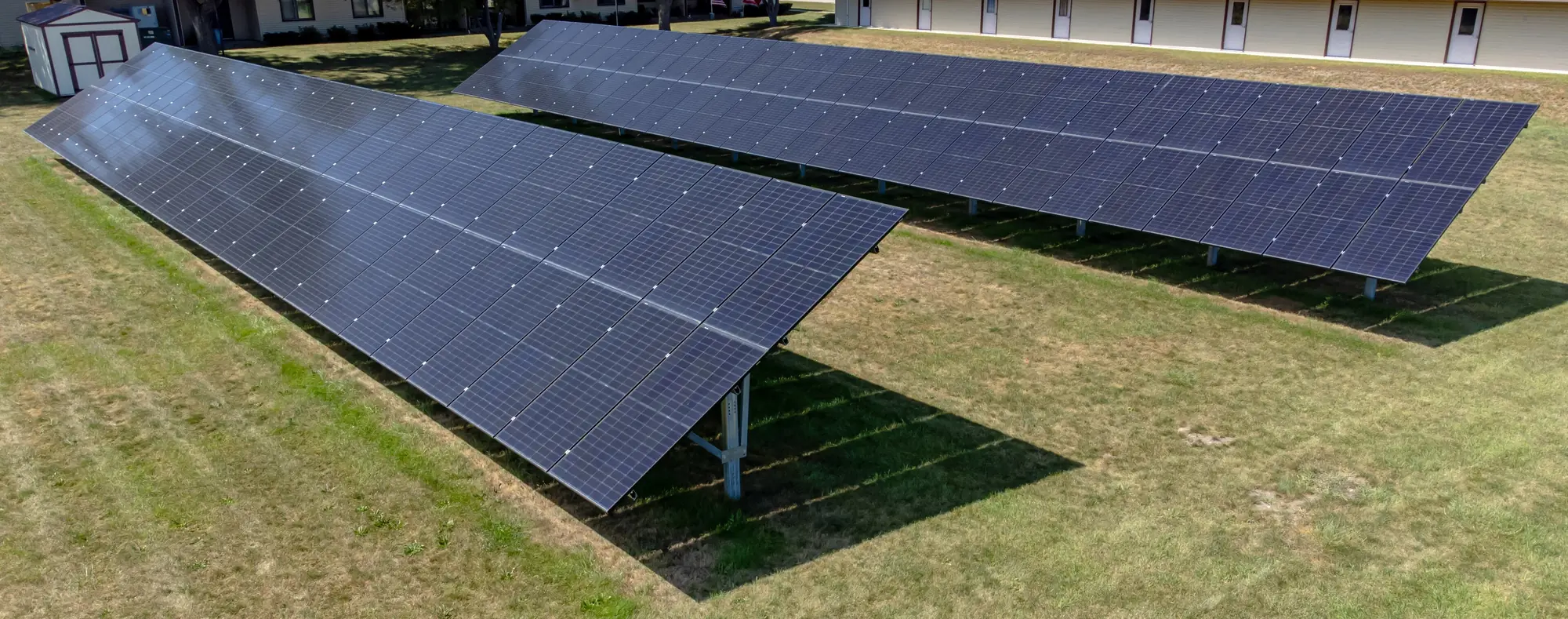
A ground array puts panels where the sun is, not where the roof faces. Around Ripon it also raises questions that no published rule we found answers yet, so they belong in writing before you sign:
- MID's mounting rule. MID requires a system "permanently mounted to a permanent structure." Ask the installer how a ground rack on an MID meter meets that, and get MID's answer before the design is final.
- MID well-pump meters. MID bills water-well pumping on a separate agricultural schedule. Can a well-pump meter on that schedule carry its own NEM 2.0 system? Ask MID before you plan a system for it.
- Ripon zoning. Inside city limits, what does Ripon's zoning allow for a ground array on a residential lot?
- County Planning. On unincorporated land, does the County need Planning approval before the building permit?
- The Stanislaus River. Ripon sits on the river. Is any part of your parcel in a mapped flood zone, and how high must equipment sit?
- City right-of-way. If a trench crosses a street or sidewalk, the City's encroachment permit checklist asks for a state contractor license, a City of Ripon business license and an erosion-control plan.
Then ask for a scaled site plan that shows the physical work:
- Clear perimeter. California's Fire Code calls for a 10-foot clear, brush-free area around ground arrays (Section 1205.5.1, per a published code library). Next to an orchard, that clearance can take space you farm.
- Trench route. The run from array to connection point (house panel, shop subpanel or well-pump service), with every crossing: driveway, leach field, irrigation mains, orchard rows. Longer runs need heavier wire, which is a priced line.
- The 811 call. USA North 811 needs at least two working days' notice before digging. The quote should name who calls. Private lines such as irrigation mains are yours to point out.
- Well and septic. The array and trench kept clear of the well head, pump line, tank and leach field, with the setback the installer used and its source.
Split the quote before you compare $/W
One total price can't tell you whether a solar quote is fair. Ask for separate lines: the array, the ground-mount extras, any battery, any panel upgrade. Then divide only the array lines by the system's DC watts (the panels' rated size).
Illustrative calculation. A quote lists $34,000 for a 12 kW ground array, with separate lines for piers and racking premium $3,200; trench 180 ft at $22/ft = $3,960; conductor upsizing and a shop subpanel $1,840 (all illustrative).
Array-only price: $34,000 − $3,200 − $3,960 − $1,840 = $25,000, and $25,000 ÷ 12,000 W = $2.08/W.
State benchmark: EcoGen Solar Cost Index, September 2026 Edition, California $2.85/W, a modeled installed cash price for solar only, before incentives.
Here the array price sits below the benchmark. The $9,000 of ground lines is the cost of siting; compare it between bids, not against a benchmark that prices no piers or trenches.
On MID, ask for one price block per system. Two meters means two systems, each with its own $900 fee and generation meter, so divide each system's array lines by its own DC watts. A single blended figure for both hides which system is expensive.
Combined prices hide the solar number too. One public price database lists a 2026 Ripon PG&E solar-plus-battery install at one price and splits it only by its own estimate. Ask for the split before you compare.
If a quote adds a battery
Keep it on its own line, with its own price. On an MID meter, the case for storage rests on the gap between self-use and the $0.0760 export credit, and MID's schedule says a battery charged from the grid earns no excess compensation. Ask how the battery would be charged and what the quote assumes it earns.
Tax lines that changed
The IRS says the Residential Clean Energy Credit is not available for property placed in service after December 31, 2025. A quote that still subtracts 30% for a system you own is using an old rule.
As of November 18, 2026, California's property-tax exclusion for active solar covers systems finished before January 1, 2027. A ground array finished in 2027 would not be excluded unless the law changes. On an MID meter, with two review stages before installation, ask what completion date the schedule really supports.
How the proposed meter plan would work in Ripon
Proposed service. NorCal Solar Services is a proposed ground-mount and rural-property solar service for homes with wells, shops and acreage. It would put the array location, trench route, setbacks and every utility meter into one written plan. Coverage of Ripon is proposed and not yet confirmed.
In Ripon the plan would carry two extra documents:
- A meter plan. Per meter: the utility, 12-month kWh, the cap that applies (MID's 115% or PG&E's limit), aggregation or separate systems, and the generation meters and fees each route adds.
- A permit route sheet. City or County desk, automated permit or plan review, the inspections, MID's six-month window where it applies, and a check that the contractor holds a current Ripon business license for city-limits work.
The site visit would compare a roof option with a ground option, each with DC kW, annual kWh and price. On a single-meter city lot the default would be a roof array with the same cap check and route sheet. Batteries and EV chargers would appear only as optional, separately priced lines.
Ripon quote checklist: questions before you sign
Use this with every installer, along with the quote checklist on this site.
- Utility per meter. MID or PG&E named for each meter, from the bill.
- Twelve months of kWh per meter. Listed separately. On MID, the Release of Information signed and the demonstrated load attached.
- Cap math shown. MID: 115% of each meter's 12-month use. PG&E: 12-month use, or up to 150% with an attestation you agree to sign.
- One system or several. On PG&E, which accounts are aggregated, with the $25 setup and $5 monthly fee per account. On MID, one system per meter.
- Fees and generation meters. MID's $900 fee per system and a generation meter for each.
- Permit desk. City of Ripon or San Joaquin County, and automated permit or plan review.
- Licenses. A Ripon business license current for the months of city-limits work, and an active CSLB C-46 or C-10.
- MID timing. Who requests MID's inspection, and how the City or County final stays under six months old.
- Array-only $/W. Array lines divided by DC watts, per system on MID, compared with the $2.85/W state benchmark.
- Ground lines itemized. Piers and racking, trench length and price per foot, conductor upsizing, any subpanel.
- Site plan. The 10-foot clear perimeter, trench route, well and septic clearances, and who calls 811.
- Battery, if any. Its own line, and on MID, how it is charged.
- Credits. Which PG&E bonus year the savings assume; on Ava, whether the 3–8 p.m. adder is counted; no 30% federal credit.