Read your bill first: LID in River Islands, PG&E and Ava elsewhere
Start with the name on your electric bill. In Lathrop it is one of two utilities, and every number in a proposal follows from it.
- River Islands (Stewart Tract): Lathrop Irrigation District (LID). LID was formed in 2002 to serve homes and businesses on Stewart Tract, the River Islands at Lathrop development, and has sold power since April 2013. In LID's words, "PG&E will continue to be the provider outside of LID territory."
- The rest of Lathrop: PG&E wires, Ava Community Energy supply. Lathrop joined Ava, which began serving the city in 2025; PG&E still owns the lines and handles interconnection. Ava says irrigation-district customers, "such as Lathrop Irrigation District," are not eligible.
So a River Islands home is not a PG&E customer, and a Mossdale or Central Lathrop home is not an LID customer. A River Islands proposal built on PG&E's Solar Billing Plan uses the wrong rules. Ask for a redo.
Before reading any savings estimate, separate two prices. The retail rate is what you pay per kilowatt-hour (kWh) taken from the grid. The export credit is what you earn for each kWh your panels send back when the house isn't using it. Each utility sets its export credit by its own rules, separate from the retail rate, so an estimate that values every exported kWh at your bill rate uses the wrong number at either address.
A Lathrop mailing address does not prove the home is inside city limits, either. Acreage with a Lathrop address can sit in unincorporated San Joaquin County, with a different permit office. Check the parcel, not the envelope.
Neighboring towns split by address too; Lodi has its own city-owned electric utility. In Lathrop the split runs through the city itself. Write the utility name on the first page of every quote you collect. A proposal that does not name LID or PG&E is not yet about your house.
How each utility caps size and credits exports
| Rule | River Islands (LID) | Rest of Lathrop (PG&E wires, Ava supply) |
|---|---|---|
| Size limit | 125% of the home's yearly usage | Annual usage, or up to 150% if you sign a statement of need |
| Size the utility suggests | About 85% of yearly usage | None stated in the CPUC rules |
| Export credit | Flat Wholesale Generation Credit per exported kWh | Hourly export credits under the Solar Billing Plan |
| Time of day | Not time-differentiated | Matters: E-ELEC peak 4–9 p.m.; Ava pays extra for 3–8 p.m. exports |
| Settlement | Credited monthly, balance rolls over, annual review and a check for a credit balance | Billed monthly; Ava trues up generation every April; PG&E trues up delivery separately |
| Who grants permission to operate | LID | PG&E |
LID: a hard cap and a flat credit
LID limits residential systems to 125% of the home's yearly usage and recommends sizing for about 85%. Its current solar program is the Wholesale Generation Credit (WGC): each kWh you export in a billing period is credited that month at one flat rate, with no extra value for exporting at 6 p.m. instead of noon. The details are on LID's solar program page.
LID's 2023 fact sheet lists $0.06 per kWh; a 2022 sample bill shows $0.04; the credit started at $0.076 and is reviewed annually. Get today's rate from LID in writing before anyone sizes your system. EcoGen's California solar incentives guide gives the same advice to customers of a city utility or irrigation district: the state's Solar Billing Plan does not apply, so get the district's rule in writing before you decide how large the system should be. It also warns against using a PG&E example to estimate those credits, which is exactly what a PG&E-based River Islands proposal does.
PG&E and Ava: hourly credits that reward timing
Outside River Islands, the CPUC's Net Billing Tariff, PG&E's Solar Billing Plan, credits exports at hourly values "usually lower than the retail rate." Solar customers go on E-ELEC, a time-of-use rate with a 4–9 p.m. peak. Size is capped at annual load plus up to 50% if you "attest to need": sign a statement that your use will grow, say for a planned EV.
Ava's Solar Billing Plan terms add an extra $0.025 per kWh for exports between 3 and 8 p.m. (CARE and FERA households get $0.01 per exported kWh instead) and a small bonus credit by the year a system connects, $0.009 per kWh for 2026, locked for nine years. EcoGen states 0.88¢ for 2026 applications, and PG&E's guide ties the value to permission to operate, so ask which year the quote assumes.
The hourly values themselves change through the year, and EcoGen describes them as "single-digit credits," so this page puts no dollar figure on them. Ask each installer to show the export values they used, by hour, and where they came from.
What this means for design. At an LID address, extra panels "to sell power back" earn one flat credit, so size to your use and face panels where they make the most kWh. At a PG&E/Ava address, timing counts: a west-facing array makes less energy (about 1,392 kWh per kW a year versus 1,634 for a south roof; modeled estimate, PVWatts, Stockton) but more of it late in the day, inside Ava's 3–8 p.m. window. An optional battery splits the same way. At a PG&E/Ava address it can carry solar into the 4–9 p.m. peak. At an LID address the flat credit gives timing no extra value, so ask the installer to show the battery's case in kWh and dollars before you add it.
Worked example: one 7.2 kW proposal at two Lathrop addresses
Take one sales proposal and check it at both addresses. You need two units for that: kW DC is the rated size of the panels, and $/W (dollars per watt) is the solar-only price divided by those watts, which lets you compare quotes of different sizes.
Illustrative calculation · not a quote. A Lathrop home uses 9,000 kWh a year (illustrative). A salesperson proposes a 7.2 kW DC south-facing roof array.
- Modeled output. 7.2 kW × 1,634 kWh per kW per year = about 11,765 kWh a year, or 131% of the home's use. (Modeled estimate: PVWatts, south roof at 22°, Stockton about 10 miles away, no shade.)
- River Islands (LID). The cap is 125% × 9,000 = 11,250 kWh. That supports about 6.9 kW (11,250 ÷ 1,634), so the 7.2 kW design is over the cap as drawn. A 6.8 kW design makes about 11,110 kWh, 123% of use, and fits. LID's suggested 85% (7,650 kWh) points to about 4.7 kW.
- Rest of Lathrop (PG&E and Ava). The limit is the annual load, 9,000 kWh (about 5.5 kW), or up to 13,500 kWh (about 8.3 kW) if the homeowner attests to need. The 7.2 kW design needs that signed statement.
- What the last kilowatt earns at LID. One kW makes about 1,634 kWh a year. Exported at the $0.06 per kWh on LID's 2023 fact sheet (confirm today's rate with LID), that is about $98 a year. At the State benchmark of $2.85/W, that kilowatt costs about $2,850, so it takes about 29 years to repay on export credits alone.
- Price check. 6.8 kW × $2.85/W = $19,380 (State benchmark: EcoGen Solar Cost Index, September 2026 Edition, prices as of September 25, 2026; a modeled installed cash price for solar only, before incentives).
In River Islands, the cap trims this proposal and LID's 85% suggestion trims it further. Step 4 shows why: a kilowatt whose output mostly leaves the house at the flat credit takes decades to repay, so the top-end panels earn their place only when the house will use that power itself. Elsewhere in Lathrop, the same 7.2 kW fits the size rule only with the signed statement, and its case rests on a real plan for more load (an EV, say) and on how much of its output lands in the 3–8 p.m. window.
Run the $/W check on your own quote
- Find the solar-only price. Take out any battery and any main-panel upgrade (in Lathrop, a separate electrical permit). For a ground mount, take out foundations or piers and trenching. In River Islands, also take out LID's application, plan-review, commissioning and meter fees if the quote passes them through.
- Divide that price by the system's DC watts (7.2 kW = 7,200 W).
- Compare with $2.85/W. Well above it, ask what is included; well below, ask what is left out.
The benchmark is a statewide model, not a Lathrop price and not a quote. Two quotes for the same River Islands home can land on different sides of it simply because one includes LID's fees and the other leaves them for you to pay.
Which permit desk and review path your layout takes
The City of Lathrop requires a permit for every solar system, whatever its size, and the layout decides the review path. Permits go through the Building Department at 390 Towne Centre Drive. The City's SolarAPP+ page and its residential solar guidelines set the routes.
SolarAPP+: new, roof-mounted, single-family
SolarAPP+ is the City's streamlined online review. It fits only a new, roof-mounted system on a single-family home, up to 38.4 kW, on a main service up to 400 A with the disconnect and busbar within the guidelines' 225 A limit. An addition to existing solar does not qualify, and neither do wall-mounted batteries over 400 pounds.
Standard review: ground mounts, additions, panel upgrades, owner-builders
Everything else goes to standard plan review: Building, Fire and, for a ground mount, Planning. The City's residential solar guidelines say "Planning Department Approval is required for Ground Mount Solar Systems." A ground-mount submittal needs a site plan, a single-line diagram, a structural engineer's stamp and calculations, and equipment cut sheets. First review takes 1–3 business days under 10 kW, and up to 10 business days over 10 kW or for ground mounts. Fire may charge its own review fee. A main-panel upgrade needs a separate electrical permit.
Whatever the path, the City adds its own conditions for contractor jobs. The installer must be a licensed contractor with an active City of Lathrop business license. Applications, fees and inspections run through the Lathrop Civic Access Portal (LCAP). Homeowners who install their own system go through standard review.
County parcels with a Lathrop address
If the parcel is outside city limits, the permit comes from San Joaquin County, not the City. The County's solar permit page covers roof and ground mounts. The County also uses SolarAPP+, but not for ground mounts. Ask whether County Planning must sign off before the building permit.
| Your layout | Permit desk | Review path |
|---|---|---|
| New roof array, city home | City of Lathrop Building | SolarAPP+ |
| New roof array, River Islands | City of Lathrop Building plus LID | SolarAPP+ or standard, plus LID plan approval |
| Ground mount inside city limits | City Building, Fire, Planning | Standard, up to 10 business days first review |
| Addition to existing solar | City of Lathrop Building | Standard |
| Panel upgrade with solar | City of Lathrop Building | Standard, plus electrical permit |
| Any array on county acreage | San Joaquin County | SolarAPP+ may fit a roof array; ground mounts do not use it |
River Islands: LID approves the plans and grants permission to operate
In River Islands, the City permit is half the job; the City's guidelines require concurrent LID review and an LID inspection. LID's solar application says it plainly: "Do Not Install Until You Have Received Approved Plans From LID."
The sequence runs like this:
- LID application and fees. Site map, one-line diagram, cut sheets, your LID bill, the contractor's license number and the DC rating. LID's posted fees total about $650 (application, plan review, commissioning and solar meter) on a 2018 schedule marked "subject to change"; confirm them with LID. Over 20 kW, add an engineering study.
- LID approval goes to the City with the permit application.
- City permit, through SolarAPP+ or standard review.
- Installation, and only after both approvals are in hand.
- Joint final. LID's commissioning inspection, scheduled 2–5 business days out, runs alongside the City's final. The contractor must attend. LID's application lists a $75 fee for a reinspection trip.
- Permission to operate (PTO). PTO is the utility's written go-ahead to switch the system on. In River Islands, LID issues it and sets the meter up for solar credits.
Generic timelines that end with the town approving interconnection miss this. An installer's River Islands schedule should show LID's inspection and PTO, not just the City final.
LID's process notes (dated 2020) say HOA approval is required only for multi-unit homes (bungalows) in its territory. If you live in one, add that approval to the start of the list, and ask LID whether the note is still current.
Where a ground mount or rural plan fits around Lathrop
Proposed service. NorCal Solar Services would put the array location, trench route, setbacks and each utility's rules into one written plan, with ground-mount and rural-property work as its focus. Coverage of Lathrop is proposed and not yet confirmed. The full roof-versus-ground comparison for acreage shows how the plan would split those costs.
| Lathrop situation | What the proposed plan would cover |
|---|---|
| River Islands lot (LID) | A roof layout sized under LID's 125% cap; the LID plan set and fees; the joint LID and City inspection. A ground or detached-structure array still counts against the same cap. |
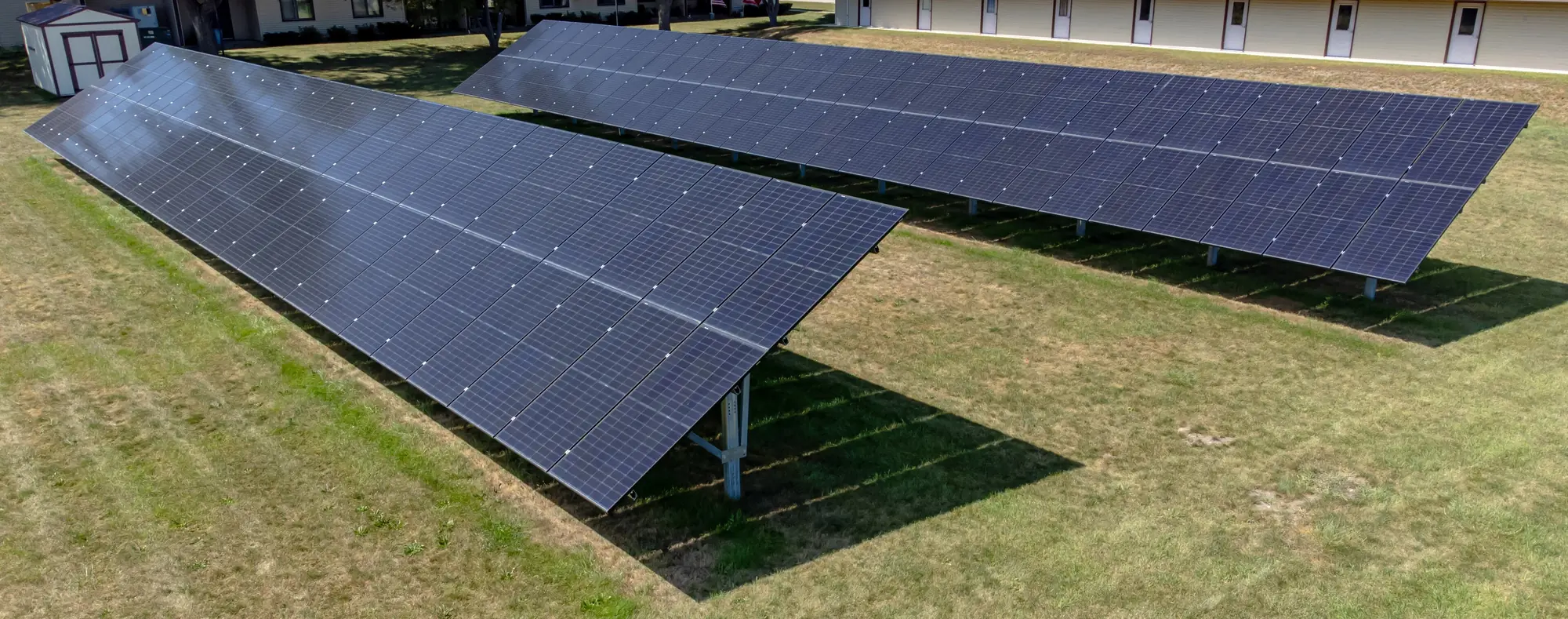
| Other city lot (PG&E and Ava) | A roof layout by default. A ground mount adds Planning approval and standard review, with a site plan, structural stamp and calculations. |
| Acreage with a Lathrop address outside city limits | County permit; PG&E wires; Ava supply; one array for house, well and shop meters where PG&E aggregation allows; an 811 ticket; a 10-foot clear perimeter. |
On a subdivision lot, output alone won't justify a ground mount's extra review: a south ground array at 30° models about 1,653 kWh per kW a year versus 1,634 on a south roof (modeled estimate, PVWatts, Stockton). Go to the ground for space, shade or roof condition.
On acreage that has a Lathrop address but sits outside city limits, the plan does more work, because the permit and the Ava schedule follow the county, not the City:
- Meters. PG&E's meter aggregation lets one system offset several meters of the same customer on the same or adjacent property, such as a house, a well pump and a shop. The accounts are chosen at interconnection, so list every meter before installation. There is a trade-off: aggregated accounts give up net surplus compensation, the payment for a yearly surplus. Ask PG&E to confirm the rule for your meters. How Ava treats aggregated or agricultural meters is unconfirmed; ask Ava.
- Ava enrollment. Ava enrolls unincorporated San Joaquin County solar customers by PG&E true-up month, June 2026 through April 2027, and you can opt out from 60 days before your month. Ask which month is yours; it decides whose supply terms the first-year estimate should use.
- Digging. Call 811 at least two working days before any trench, and mark the dig area in white.
- Fire clearance. The 2025 California Fire Code (section 1205.5.1, as published in a code library) calls for a 10-foot clear, brush-free perimeter around ground arrays. Confirm it with the fire reviewer on your permit.
Already have builder-installed solar? Ask how an addition is permitted and counted
If your Lathrop home came with builder-installed solar, adding more panels is a different job from a new system.
- Permit path. An addition is not eligible for SolarAPP+ in Lathrop. It goes through standard review.
- The LID cap. LID's posted documents don't say how it counts an existing system plus an addition against the 125% limit. Ask LID before you sign.
- An older LID net-metering system. LID closed net metering on July 31, 2018, and says customers who joined before then stay on it. If your River Islands system dates from before that, ask LID in writing whether adding panels moves any part of it onto the Wholesale Generation Credit.
- PG&E bonus. The CPUC excludes code-required new-home solar from the Net Billing adder. Ask how the estimate treats old and new panels.
- Who services it. LID says it "doesn't do any work on solar systems" and points SunPower owners to Solaria. Ask who will service the original system and whether the addition affects its warranty.
What still counts in 2026: no 30% credit, a property-tax deadline
Some pages ranking for Lathrop still mention a 30% federal tax credit. For a system you buy, that is out of date. The IRS says the Residential Clean Energy Credit is not available for property placed in service after December 31, 2025. A cash or loan payback that includes it is wrong.
California's property-tax exclusion for new solar ends for systems finished on or after January 1, 2027 (as of November 18, 2026). A ground mount finished in 2027 is not excluded unless the law changes. In Lathrop the layouts run on different clocks: a new roof array can use SolarAPP+, while a ground mount waits up to 10 business days for first review and needs Planning approval, and a River Islands job cannot start until LID approves the plans. If the exclusion matters to you, get a target completion date in writing; LID or PG&E inspection timing is outside the installer's control.
PG&E interconnections need a signed CPUC Solar Consumer Protection Guide (Version 4 for contracts signed on or after December 15, 2026). The CPUC does not state that rule for LID, so in River Islands rely on the contract and LID's documents.
Lathrop quote checklist: questions before you sign
Hand this list to every installer, or use the quote checklist on this site. Ask for each answer in writing.
Utility and size
- Which utility is the proposal built on: LID or PG&E with Ava? Show it on page one.
- What share of my last 12 months of use does the design produce? In River Islands, it must be 125% or less. Elsewhere, over 100% needs my signed statement of need.
- Which export credit did you assume, and where does it come from: LID's WGC (and LID's current rate in writing), or the Solar Billing Plan plus Ava's 3–8 p.m. extra?
- Which year's bonus credit does the estimate use?
Permit and approvals
- SolarAPP+ or standard review, and why? A ground mount, an addition or a panel upgrade cannot use SolarAPP+.
- Does your company hold an active City of Lathrop business license, and who files in LCAP?
- For River Islands: who submits the LID application, who pays the LID fees, and is installation scheduled only after LID's approved plans?
- Who attends the joint LID and City final, and who pays a reinspection trip?
- If my parcel is in the county: who files with San Joaquin County, and does Planning sign off first?
- If one array will offset several meters (house, well, shop): which meters, does PG&E aggregation apply, and what do I give up in net surplus compensation?
Price and paperwork
- What is the solar-only price per DC watt, with any battery, panel upgrade or ground work on separate lines? Compare it with the $2.85/W State benchmark.
- Does the payback leave out the 30% federal credit?
- If I already have builder-installed solar, how is the addition permitted, counted against any cap, and serviced?
- Which license do you hold? The Contractors State License Board (CSLB) allows A, B, C-10 (electrical) and C-46 (solar) contractors to install PV. Check it on the CSLB site.
- Will I get the CSLB solar disclosure document before signing? California gives you three days to cancel.
A quote that cannot name its utility, cap and permit path is not ready to sign.