Check which side of the city line your parcel is on
First question for every installer: is this parcel inside the City of Manteca, or on unincorporated San Joaquin County land, where the County issues permits?
A Manteca mailing address does not answer this. A county island is unincorporated land with city on all or most sides. In a December 2018 report on unincorporated islands, the San Joaquin Local Agency Formation Commission (LAFCo, the agency that oversees city boundaries) counted five islands inside Manteca, with profiles for Airport Way/Lathrop Road, Manteca-North, Joseph Road and Moffat Boulevard. Fringe acreage with a Manteca address can be county land too.
Land can be annexed after 2018, so the list may already be out of date. The LAFCo island profiles list no city water or sewer, which points to private wells and septic systems. Confirm that for your own parcel before anyone draws a trench.
How to settle it. Give your Assessor's Parcel Number (APN, printed on your property tax bill) to the City of Manteca Building Safety Division and ask whether the parcel is inside city limits. If it is not, San Joaquin County Community Development is your permit office. Write the answer, and who gave it, on the first page of every quote.
| Inside City of Manteca limits | County island or fringe parcel with a Manteca address | |
|---|---|---|
| Permit office | City of Manteca, Building Safety Division | San Joaquin County Community Development, Building |
| Fast route for a roof array | Symbium instant permit for rooftop solar or battery storage | SolarAPP+ for roof-mounted systems with no trenching |
| Ground mount | Accela "Solar" permit, which covers ground and roof mounts | Standard submittal with a site plan, plus structural and engineering items |
| Who supplies power and credits exports | PG&E bundled service (Manteca has not joined Ava) | Ava Community Energy since 2026, unless the account opted out |
| What to map before a trench | Buried utility lines, located through 811 | LAFCo's 2018 island profiles list no city water or sewer; ask about a well and septic |
Three things switch together at the city line: the permit office and its fast-track platform, the company that credits your exports, and probably what lies underground where a trench would run. A quote that gets the first row wrong was written for a different house.
Permit route and timing on each side
Ask each installer to name the permit route for every layout they propose. Then check their timing against what the office itself publishes.
Inside city limits
The City offers an instant residential solar and energy storage permit through Symbium, an automated permitting platform: the applicant enters the address, answers questions about the system, pays and downloads the permit. Inspections are booked in the City's Accela Citizen Access Portal.
That instant route covers rooftop solar or storage only. A ground mount goes through Accela: the City's permit-type guide describes the "Solar" permit as a new photovoltaic system or addition, "ground mount or roof mount". For residential solar that goes to plan review, the City's expected plan review table, dated November 5, 2026, lists 4 working days for a first submittal and 4 for each resubmittal. "Expected" is the City's word, not a guarantee.
The City's development fee schedule, effective August 15, 2026, lists "Solar Photovoltaic - Residential (Rooftop)" at $409 per application, subject to change. It has no residential ground-mount line, so ask the Building Safety Division what a ground array would cost to permit before you compare a ground quote with a roof quote.
If a proposal for a city rooftop system says permitting takes "two to four weeks", ask why. The City publishes an instant rooftop route and a 4-working-day expected review. A longer estimate may have a good reason (a resubmittal, a main-panel upgrade), but the installer should be able to name it.
On county land
The County requires a building permit for roof-mounted and ground-mounted solar, through an online Accela application its solar permit page says takes about 20 minutes. Its Solar (PV) Permit Checklist, modified September 2026, sends roof mounts without trenching to SolarAPP+, a national automated plan check. Ground mounts need a standard submittal:
- a site plan showing property lines, structures, a north arrow, lot dimensions, easements and equipment;
- a structural analysis if the array's dead load is over 3 pounds per square foot;
- an engineer's report for wind exposure C and seismic design category D.
An older County checklist required Planning approval before Building would accept a ground mount. The current one does not say so. Ask the County whether Planning must sign off first, and put the answer on the permit route before the schedule is promised.
Draw Manteca's fire paths before counting panels
The City's residential solar submittal checklist amends the state's emergency-egress pathway section. An egress window is the opening a person uses to escape a fire, such as a bedroom window. Where panels sit below one, Manteca requires a straight pathway, 3 feet wide, from the roof edge to that window, over framing that can carry firefighters. The checklist adds: "this three feet clearance also needs to be around fireplace chimney or HVAC equipment on the roof."
It also lists the roof access paths:
- on a hip roof, a 3-foot path from eave to ridge;
- on a single-ridge roof, two 3-foot paths from eave to ridge;
- panels at least 18 inches from hips and valleys and 3 feet below the ridge.
Plans must be signed by a California-licensed engineer or a contractor holding an A, B, C-46 or C-10 license, with the license number on each sheet.
Why this matters on a two-story house. Picture second-floor bedroom windows above a first-floor roof. If that lower roof faces south, it is likely the plane an installer most wants to fill. Each window needs its own 3-foot path, and every path runs straight through the panel area. A rooftop air-conditioning unit or a chimney on the same plane takes its own 3-foot ring.
A caveat. The checklist PDF was created in 2017 and cites section numbers from an older code cycle. Ask the Building Safety Division whether the egress amendment still applies as written, and ask each installer which version they designed to. Two quotes for the same roof can differ by several panels on this point alone.
What to ask for. A roof plan with every path and clearance drawn in, before the kW figure is final. A panel count without that drawing can't show whether the layout will pass.
When a ground or shop-roof array is the honest choice
On a city lot, a roof array is the default, and that is fine. A ground mount or shop roof earns a place only when the house roof loses too much to the fire paths, faces the wrong way or runs out of room.
On a city lot. A ground array uses the Accela "Solar" permit. Manteca's zoning code (Chapter 17.40, Accessory Structures) caps all accessory structures at 30% of the actual rear-yard area and measures setbacks to any projection. Its table covers buildings, pools, decks and play equipment but does not mention solar. Ask Manteca Planning whether a ground array counts toward that 30% before anyone designs one, because the answer can shrink a backyard array or rule it out.
On county acreage. Three site rules come before the panel count:
- Fire clearance. The 2025 California Fire Code (section 1205.5.1) calls for a 10-foot clear, brush-free area around a ground-mounted array. That ring takes ground and has to be kept clear every season.
- Call before you dig. An 811 ticket is the free request that gets buried utility lines marked. USA North 811 asks you to call at least two working days before digging and to pre-mark the area in white.
- Route the trench around what you can't see. Mark the septic tank, leach field, well head and pump line on the site plan before the trench is drawn. A shorter run across the leach field is not a saving.
Farm neighbors are a site question too. Manteca's building-permit Agricultural Uses Disclosure says nearby farming can "occasionally generate dust, smoke, noise, and odor." If your array would sit near active fields, ask how the panels would be cleaned and reached. Don't accept a production-loss figure for dust unless the installer can show where it came from.
Who credits your exports: PG&E in the city, Ava on county land
PG&E owns the wires and handles interconnection across Manteca. The city line changes who supplies your power and how your exports are credited.
The export credit is what you earn for each kilowatt-hour (kWh) your panels send to the grid when the house isn't using it. Under California's current billing it is an hourly value, well below the retail rate you pay for grid power; EcoGen describes exports as earning "single-digit credits". So a layout sized to what the house uses matters more than one built to export the most.
Inside city limits: PG&E bundled. Ava Community Energy's service history page says Manteca has not voted to join Ava. City customers go on PG&E's Solar Billing Plan, which puts the home on E-ELEC, a time-of-use rate (the price changes by hour) with a 4–9 p.m. peak. PG&E adds a small export bonus credit for customers who start before 2028. EcoGen puts it at about 0.9¢ per kWh for 2026, while PG&E says the value is set at permission to operate (PTO, the utility's go-ahead to switch the system on). Ask which year the quote assumes.
On county land: Ava supply. Ava began serving unincorporated San Joaquin County in 2026 and is enrolling solar customers on a rolling schedule through April 2027; accounts that opt out stay on PG&E bundled supply. Check the supplier named on your current bill. Ava's Solar Billing Plan pays non-CARE/FERA customers an extra $0.025 per kWh for exports between 3 and 8 p.m., adds a $0.009 per kWh bonus for 2026 interconnections locked for nine years, and trues up every April, paying balances over $100, typically in June or July.
Then there is the meter count. If the house, a well pump and a shop each have a meter, PG&E's aggregation program can let one array serve several meters held by the same customer on the same or adjacent parcels. The meters are chosen at interconnection, and PG&E's program materials say aggregated accounts give up net surplus compensation (the payout for a yearly surplus). How Ava treats an aggregated pump meter is unverified, so ask both PG&E and Ava before the design is final.
Local press has reported for years on South San Joaquin Irrigation District's effort to take over PG&E's retail service in Manteca. PG&E serves Manteca today. Ask how the proposal would handle a change of provider.
Check the price per watt against the state benchmark
Price per watt lets you compare quotes of different sizes. DC kW is the panels' combined rated output: eighteen 400-watt panels make 7.2 kW, or 7,200 W.
- Remove what isn't the array. Take out any battery and main-panel upgrade and, for a ground mount, the trench, piers, racking premium and conductor upsizing.
- Divide. Solar-only cash price ÷ DC watts.
- Compare. Set the result beside the state benchmark.
State benchmark: EcoGen's Solar Cost Index puts California at $2.85 per watt, with a typical 6.70 kW system at about $19,095 (September 2026 Edition, prices as of September 25, 2026; host-owned cash price, solar only, before incentives). It is a modeled state figure from EcoGen's solar database, not a Manteca price or a quote.
What you strip out depends on the side of the city line. A city rooftop quote may need only a battery or panel upgrade removed. A county ground-mount quote carries trench, foundation and wire-size lines that a rooftop quote never has, so its whole-bid figure will look high until those lines come off. A gap from $2.85 proves nothing by itself; it is a reason to ask what drives it.
Two incentive corrections. The IRS says the Residential Clean Energy Credit is not available for property placed in service after December 31, 2025. If a proposal for an owned system still subtracts 30%, ask for the price without it.
Second, as of November 18, 2026, California's property-tax exclusion for active solar systems, which keeps the system's value out of a reassessment, covers systems finished before January 1, 2027. One finished in 2027 is not excluded unless the law changes. With weeks left in the year, timing differs by route: a city rooftop job can use the instant permit, while a county ground mount needs a site plan, plan review, an 811 ticket and a trench. If a quote counts on the exclusion, ask for a written completion date. This is not tax advice.
Worked example: one 7.2 kW plan at two Manteca addresses
Illustrative example · not a quote. Two households with "Manteca, CA" addresses each want about 7.2 kW DC. Every price, size and length is an illustrative calculation; only the state benchmark, the City fee, the Ava adder and the City and County rules are sourced. Yields are a modeled estimate (PVWatts, downtown Stockton about 12 miles away, no shade), not a Manteca measurement.
Home A: two-story house inside city limits. The best south-facing plane is the first-floor roof under two bedroom egress windows. Manteca's amended rule needs a straight 3-ft path from the roof edge to each window. Illustrative: a 400 W panel is about 3.7 ft wide in portrait, so in a two-row array each path costs two panels, or 0.8 kW. Two windows move about 1.6 kW to the west roof. Permit: Symbium instant rooftop permit, fee $409. Supply: PG&E bundled on E-ELEC.
- Modeled yield. South roof 1,634 kWh per kW per year; west roof 1,392. As drawn: 5.6 kW × 1,634 + 1.6 kW × 1,392 = 9,150 + 2,227 = about 11,380 kWh a year, against about 11,765 kWh if all 7.2 kW faced south. The fire paths cost about 3%.
- Price check. An illustrative $21,600 solar-only cash quote ÷ 7,200 W = $3.00/W, about 5% above the State benchmark of $2.85/W. Ask what explains it: panel choice, the split layout or an electrical upgrade.
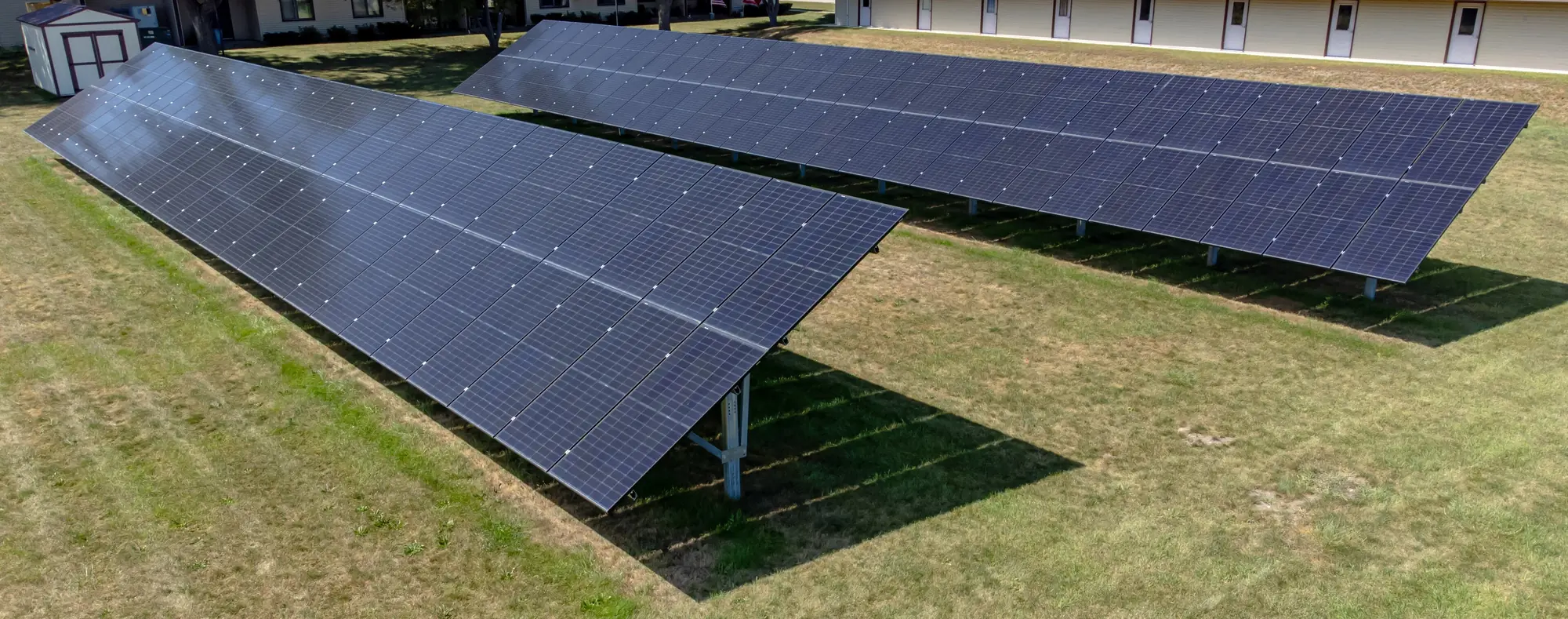
Home B: county island lot with a well and septic. The roof faces east and west; there is open ground south of the house. Option B is a 7.2 kW south-facing ground mount at 30°. Permit: San Joaquin County, standard submittal with a site plan, since SolarAPP+ excludes ground mounts and trenching. Supply: Ava.
- Whole bid. An illustrative $29,880 ÷ 7,200 W = $4.15/W. It looks expensive until the ground lines come off.
- Ground lines (illustrative). Trench and conduit, 150 ft routed around the leach field: $4,500. Piers and ground racking premium: $3,600. Conductor upsizing for voltage drop: $900. Total: $9,000.
- Array only. ($29,880 − $9,000) ÷ 7,200 W = $20,880 ÷ 7,200 = $2.90/W, within 2% of the State benchmark. The premium is ground work, not overpricing.
- Modeled yield. Ground mount facing south at 30°: 1,653 kWh per kW per year × 7.2 = about 11,900 kWh a year. The east-west roof split: about 1,391 × 7.2 = 10,015 kWh. The ground mount makes about 19% more.
- Ava adder (illustrative). If 1,000 kWh a year leave the house between 3 and 8 p.m., the adder pays 1,000 × $0.025 = $25 a year. Small; the full value of exports depends on hourly credits not shown here.
Home A's question is design: the fire paths cost little energy, so the price gap is what deserves a question. Home B's question is scope: the high whole-bid figure is mostly trench and foundation work, and it buys more output. Neither can be judged on the headline price per watt.
What the example leaves out matters too. Home B's extra output is worth less for every kWh exported at a single-digit credit than for every kWh the house uses itself, and its longer permit and trench steps leave less room for a 2026 finish. Ask each installer to show the kWh the house would use directly, not only the yearly total.
How the proposed ground-and-acreage plan applies in Manteca
Proposed service: NorCal Solar Services is a proposed solar service for San Joaquin County homes, built around one written plan for ground mounts, wells, shops and acreage. Coverage of Manteca is proposed and not yet confirmed.
In Manteca, the plan would follow the city line:
- City tract or two-story home. The plan would default to the roof, draw Manteca's fire paths before counting panels, and add a permit route sheet and a responsibility sheet saying who files what. It would not push a ground mount where the roof works.
- City lot with a big yard or a shop. The plan would compare house roof, shop roof and ground, each with DC kW, modeled yearly kWh and a cash price, after asking Planning about the rear-yard limit.
- County island or fringe acreage. This is where the plan fits best: the County permit route, a scaled site plan marking property lines, well head, pump line and leach field, the trench route with its crossings and 811 ticket, the 10-foot clear perimeter, Ava supply, and a meter list before interconnection.
Ground costs would sit on separate lines: piers, racking, trench per foot and conductor upsizing. A battery, EV charger or main-panel upgrade would appear only as optional lines.
What you would prepare. Under the proposal, a homeowner would bring three things to the first conversation, and they help with any installer:
- the APN or address, so the city-or-county question is settled first;
- the last bill and 12 months of use for every meter (house, well pump, shop), with the supplier and any agricultural rate noted;
- a rough sketch of what is underground: septic tank and leach field, well head and pump line, irrigation mains, propane lines and old trenches.
Manteca quote checklist: questions to ask before you sign
Use these with any installer. The quote checklist on this site follows the same order.
- Which side of the line? The quote should state whether the parcel is inside City of Manteca limits or on County land, and who confirmed it.
- Which permit route, and who files it? City: Symbium instant rooftop permit, or the Accela "Solar" permit for a ground mount. County: SolarAPP+ for a roof with no trenching, or a standard submittal. Ask who applies and who books inspections.
- What fee and timing are assumed? In the city, check the $409 rooftop fee and the 4-working-day expected review. For a city ground mount or any County project, get the fee in writing.
- Is every fire path drawn? Ask for a roof plan with each egress window path, the ridge and hip paths, and chimney or HVAC clearance, and whether the City confirmed the 2017 amendment still applies.
- Does a ground array fit the rules? On a city lot, ask whether Planning counts it toward the 30% rear-yard limit. On county land, ask whether Planning must sign off before Building.
- Where are the well, pump line and leach field? The site plan should mark them, show the trench route with depth and length, keep a 10-foot clear perimeter, and name who opens the 811 ticket.
- Which supplier and which bonus year? The quote should name PG&E bundled or Ava, the E-ELEC rate and the bonus year assumed, say whether the Ava 3–8 p.m. adder is included, and explain how a change of provider would be handled.
- Which meters? List every meter on the parcel and ask whether aggregation applies and what it gives up.
- What is the solar-only price per watt? Battery, panel upgrade, trench, piers and conductor upsizing go on separate lines. Compare the array price with $2.85/W, and make sure no 30% federal credit is subtracted for an owned system.
- When will it be finished? If the quote counts on the property-tax exclusion, it needs a written completion date before January 1, 2027.
- Is the contractor licensed? On the Contractors State License Board site, check for an A, B, C-10 or C-46 license. Get the state's solar disclosure document before signing, and note the cancellation period (at least three days).
Compare quotes only once each one answers every line. A quote that skips the first line is still a guess about your parcel.